

This is a math problem. Treat all 5,000 SKUs equally and you'll still be enriching in 2027. Tier them by revenue. Run automated extraction on the bulk. Put people on the high-value edge cases. Two people and a decent extraction pipeline can clear this in 90 days.
Do the math first
A large electrical distributor sat on 800,000 unclassified products. Manual enrichment got them through roughly 1% per year. At that rate, clearing the backlog is a multi-decade project.
Your backlog is smaller. The math is the same. 5,000 SKUs at 40% completeness, 50 enriched per week manually, two years to finish. But you'll add 3,000 new SKUs in that time. Your PIM ends up at 55% instead of 40%. The pile grows faster than you can work through it.
Manual enrichment just doesn't scale. Automated extraction from datasheets processes a SKU in seconds. So you automate the extraction and put people on reviewing output and handling exceptions.
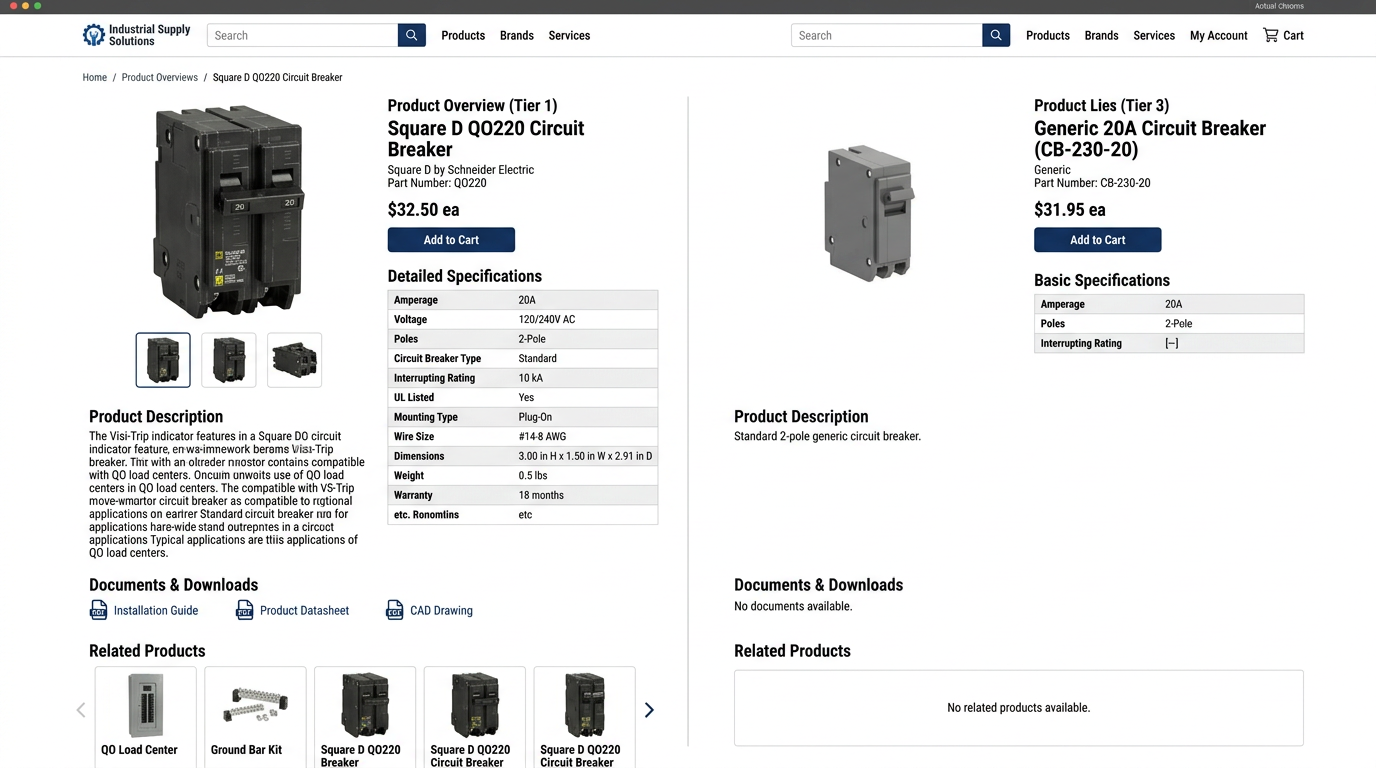
Your catalog has the same 80/20 split
Pull your sales data. In most electrical distributor catalogs, 10-20% of SKUs drive 80-90% of revenue. Yours probably looks like this:
| Tier | SKU count | % of catalog | Revenue contribution | Page views/month |
|---|---|---|---|---|
| Tier 1 | 500 | 10% | ~75-80% | 15,000+ |
| Tier 2 | 1,500 | 30% | ~15-20% | 5,000-15,000 |
| Tier 3 | 3,000 | 60% | ~5% | Under 5,000 |
Your top 500 SKUs drive three-quarters of your business. They deserve 95% completeness with hero images, 5-8 key specs, and full technical documentation. The next 1,500 SKUs need 70% completeness: image, short description, 3 key specs. The remaining 3,000 SKUs can sit at 40% until someone actually searches for them.
Not all SKUs deserve the same effort. Accept that, automate the extraction, and have a person review output instead of doing the lookup.
Pull 12 months of revenue by SKU from your ERP. Export page view counts from Google Analytics or your ecommerce platform. Join them in a spreadsheet with SKU as the key.
Sort descending by annual revenue. The top 500 SKUs become Tier 1. Flag any SKU with revenue over $10,000/year as automatic Tier 1 regardless of rank.
For SKUs not in Tier 1, filter for page views over 50/month. These are your Tier 2 SKUs. They have search demand even if revenue is low, which often means a data or pricing problem.
Remaining SKUs get baseline enrichment only until traffic justifies promotion. Set a rule: if page views exceed 5 in a month, move to the enrichment queue.
Revenue over $10K/year: Tier 1, regardless of traffic. Revenue under $10K but page views over 50/month: Tier 2, likely a data or pricing issue. Zero sales but added in last 90 days: Hold in Tier 2 for one quarter, then reassess. Low revenue and low traffic: Tier 3, enrich on-demand only.
Field prioritization: what actually drives conversion
Not all fields matter equally. Focus on what buyers actually use to decide: image, voltage, amperage, wire gauge, enclosure type. Past that, you hit diminishing returns fast. For the high-volume technical fields, use validators instead of manual spot checks: validate GTIN barcodes, check IP ratings, and verify NEMA enclosure types before a reviewer spends time polishing descriptions.
High-impact fields for Tier 1: product image (hero angle), short description (2-3 sentences), voltage, amperage, poles or wire gauge, enclosure type or mounting style, price and availability.
For Tier 2, cut to the essentials: image, 2-sentence description, and 3 key specs only. For Tier 3, baseline is manufacturer name, part number, and price. Enrich when traffic justifies it.
Before: Tier 1 circuit breaker at 40% completeness
- Part number: CTL3P240A
- Manufacturer: Eaton
- Price: $142.50
- Description: 3-pole circuit breaker
After: same SKU at 95% completeness
- Part number: CTL3P240A
- Manufacturer: Eaton
- Price: $142.50
- Description: Industrial molded case circuit breaker with thermal-magnetic trip, 240V AC rated
- Image: hero shot showing front panel and terminals
- Voltage: 240 V AC
- Amperage: 30 A
- Poles: 3
- Enclosure: NEMA 1
- Trip curve: Standard thermal-magnetic
Weeks 2-4: Enrich Tier 1 with automated extraction
Run all Tier 1 SKUs through a structured extraction pipeline. Feed in manufacturer datasheets and the pipeline returns typed fields: voltage, amperage, wire gauge, enclosure type, with source page for traceability. High-confidence results go straight to the PIM. Low-confidence results go to a review queue where a person verifies them against the source PDF.
Throughput: seconds per SKU instead of 10 minutes each. One person reviews flagged results and handles exceptions. Two people knock out all 500 Tier 1 SKUs in 2-3 weeks, review included.
Weeks 5-8: Enrich Tier 2 at 70% target
Target drops to 70%. Skip extended specs and marketing copy. Image, short description, 3 key attributes. Same pipeline, narrower schema, smaller review queue.
Two people clear 1,500 Tier 2 SKUs in 4 weeks. Most of that time goes to the 10-15% where extraction returns low confidence, usually scanned datasheets or non-standard terminology.
Weeks 9-12: Triage Tier 3 on demand
For the long tail, enrich on-demand when someone searches or views the product. Set up a workflow flag in your PIM: if page views exceed 5 in any 30-day period, promote to the enrichment queue. Otherwise, leave at baseline.
You'll opportunistically enrich 200-300 Tier 3 SKUs in the final 4 weeks. The rest sit at 40% completeness until traffic justifies the effort.
- Week 1: SKU ranking complete, Tier 1/2/3 assignments in PIM
- Week 2: Extraction pipeline running on Tier 1 datasheets
- Week 3: 250 Tier 1 SKUs enriched and reviewed
- Week 4: All 500 Tier 1 SKUs at 95% completeness
- Week 5: Extraction pipeline running on Tier 2
- Week 8: 1,500 Tier 2 SKUs at 70% completeness
- Week 10: On-demand enrichment workflow live for Tier 3
- Week 12: 200-300 Tier 3 enriched, pipeline tuned for ongoing use